
Dyson V15 Detect Review: Is It Worth It? (Real Home Tests)
I swept this floor the day before and the Dyson V15 Detect still lit up dust across every inch of it. That's the moment that sells this machine, and it happens in the first thirty seconds.
But I didn't want to make another video about one cool feature. I tested all four attachments through a real house — two kids, a minivan, a workshop, carpet, tile, vinyl plank, a mattress and a treehouse. Here's what held up, what didn't, and the one job I'd still reach for the shop vac.
Quick Facts
- Product: Dyson V15 Detect cordless stick vacuum
- Price: $649-$849
- Weight: 6.8 lbs
- Run time: Up to 60 minutes, varies by mode and attachment
- Comes with: Two cleaner heads, two tools, extension wand, wall dock, charger
- Bottom line: Worth it, and we're keeping it
The Situation
This is a DIY channel, but DIY involves cleanup. I'm also the one responsible for the stairs and keeping the house reasonably tidy, so I had two questions going in.
Can it keep up with a busy family? And can it handle the mess a projects guy makes?
My theory was that it wouldn't replace a shop vac but might come close. That turned out to be half right, and I'll get to the half that isn't.
⚠️ Before I Get Into It
A few things to be clear about.
Lowe's sent me this machine, so take that into account. What I can tell you is that nobody told me what to say and nobody saw this before it published.
I'm not a professional product reviewer and I didn't do laboratory testing. What I have is a house with real dirt in it and three weeks of using this thing like I'd use any vacuum.
And a safety note that matters: this is not a wet/dry vacuum. Fine drywall dust and construction debris can damage the motor and the filter. More on that below, because it's the single most important caveat in this review.
What's In the Box
Everything arrived well padded in an oversized box.
- Digital Motorbar cleaner head — all floor types, with de-tangling technology
- Fluffy Optic cleaner head — hard floors, with the illumination feature
- Mini Motorized tool — powered head for stairs and upholstery
- Crevice tool — narrow, for everything tight
- Extension wand
- Wall dock with all mounting hardware
- Charging cord — works with or without the dock
The main unit is a dark grey that reads as high quality, and the whole thing clicks together intuitively. At 6.8 pounds it's genuinely light.
One downside worth naming up front: there's no on/off switch. You hold the trigger the entire time you're vacuuming. For most jobs that's fine; for a long session it's something you notice.
How I Tested It
Attachment 1 — Digital Motorbar head
This is the do-everything head, and the one with the de-tangling claim.
On long-pile carpet it adjusts power automatically — you can hear the motor change as it hits deeper pile, and the screen shows it stepping up. There's a small lever that makes a real difference here: down is harder to push on high pile, up glides and lets the suction work.
Then I tested hair, which is the thing everyone wants to know about.
Here's the honest answer: the de-tangling works, but not completely. Most of the hair cleared. Some stayed wrapped around the middle of the bar. Two reasons, and they're both worth understanding before you buy:
First, the little white teeth that comb hair off the brush bar don't run the full width. There's a gap in the center. Hair that lands dead center has nothing to strip it off.
Second, it only de-tangles while the head is on the carpet. Flip it over to inspect it, like I did for the test, and the mechanism isn't working.
So: much better than a normal vacuum, where hair just stays wrapped no matter what. Not a machine you'll never pull hair off of. I'm happy with it, but "de-tangling" oversells it slightly.
This head also handled shake tile, flat tile, vinyl plank and thin rugs, and it cranks almost flat to slide under a stair tread or a chair.
The particle sensor
Partway through the carpet test the sound changed, and that's worth explaining. There's a sensor that counts and measures particles as you vacuum, showing them live on the screen — microscopic dust, allergens, dust mites. When the graph stops rising, that's your signal the area is actually clean rather than looking clean.
The Dyson app walked me through what the readout means, and it's worth downloading for that alone.
Attachment 2 — Fluffy Optic head
This is the best feature on the machine, and it isn't close.
It's a laser-like light — not actually a laser — angled very low across hard floors so it throws shadows off dust too fine to see. With it off, the floor looks clean. With it on, it's horrifying.
The useful part is that it works in both directions: pull the head back over a spot you just cleaned and nothing lights up. That's instant confirmation, which no other vacuum gives you.
Fair warning that this is a rabbit hole. You will spend an hour chasing dust you never knew about. I handed it to my kids and they went after the house on their own, which has never once happened with a normal vacuum.
Attachment 3 — Mini Motorized tool
Stairs are the bane of my existence, and this is the tool that changed that. Powered brush bar in a small head, light enough to work one-handed on a stair tread. It makes a bit of noise, which is the brush digging into the pile and pulling hair up.
Note that this tool does not have de-tangling technology. You'll pull hair off it by hand. Not a deal breaker, just know it going in.
On the couch it pulled up fine particles from cushions the kids have been sitting on for years.
On the mattress, one real caution. We stripped the bed to bare mattress, and ours has a thin built-in protective liner rather than a thick quilted top. The suction is aggressive enough that the liner bunched up and started pulling at the material. If your mattress has a thick top cover you'll be fine. If it's thin like mine, go gently or skip it.
Attachment 4 — Crevice tool
The most versatile thing in the box, and the one I used in the most places.
In the van: cupholders I hadn't cleaned in longer than I'd like to admit, the kids' private snack stash behind the seats, and the gaps behind the steering wheel that nothing else reaches.
In the garage: cobwebs along the vertical door track, sawdust and scraps on the workbench, corners, baseboards, doorways.
Around the house: the drop zone shoe rack I built, windowsills with the windows cranked open, couch cushions with the cushions out, and the gas range for crumbs between grates.
Even the treehouse, because there's no cord and you can just walk outside with it.
Suction test
Dyson claims 240 air watts for this machine. A typical vacuum runs 100 to 200, so that's a meaningful jump — air watts measure how electricity converts into actual airflow and suction.
I ran an unconventional test. On Boost mode, attachments off, it lifted a treated two-by-four weighing roughly two and a half pounds. I also tested in on the empty box (filled with its packaging material, weight of 2.2 pounds). It lifted it easily, despite being slightly unbalanced.
Battery, bin and cleaning
Battery life tracked close to the claim in normal use. Boost mode drains it fast, which is expected.
The bin is 0.2 gallons, which is on the small side. You'll empty it more than you expect. The offset is that emptying is genuinely no-touch — slide the red collar forward and the contents drop out. Clumpy debris falls clean; hair sometimes needs a finger to encourage it.
Cleaning is straightforward. The main reservoir detaches and rinses under water. The section above it does not go under water — wipe that with a rag. The filter rinses out and then needs a minimum of 24 hours to dry completely before it goes back in.
Prefer to watch?
Here is the video on YouTube.
Where It's the Wrong Tool
This is the part I want to be loudest about, because it's the one that can cost you a machine.
This is not a shop vac and it is not wet/dry. Fine particles like drywall dust can damage the motor and clog the filter. Keep your shop vac in the garage and use it for anything that produces fine construction dust or wet mess.
It handled sawdust and workbench scraps on my bench without complaint. Drywall is a different animal.
The DIY Part
Two things I did that weren't in the manual.
Wall mounting. I used a level to get it straight both ways, pre-drilled, and used heavier wall anchors than the ones included — I didn't have a stud behind that section of drywall, and I'd rather over-build a mount that's holding a vacuum at head height. Into a stud is better if you have one.
A custom attachment rack. The dock holds the vacuum but not the extra tools, so I built one from scrap wood. Primed and painted it, drilled holes the same diameter as the attachment necks — conveniently they're all the same — and assembled it with wood glue, a couple of brad nails, and exterior deck screws. It came out practical and reasonably good looking.
I also fished the cord through the wall for a hidden-cord look. That one I'm showing, not recommending.
The Verdict
Worth every penny. We're keeping it.
The combination that sold me isn't the suction number — it's that the illumination shows you what you missed, and the sensor confirms when you're done. I've been cleaning my various homes for twenty-five years based on whether it looked clean. It turns out looking clean and being clean are two different things.
The fact that it goes from the stairs to the van to the workbench without plugging anything in, this is clearly a machine that actually fits how a family with projects lives.
A Note on "Your Setup Will Probably Be Different"
Mine is a house with carpet, tile, vinyl plank, two kids, a minivan and a workshop, in the Midwest where winter tracks in constantly.
If your home is all hard floors, the Fluffy Optic head is doing most of your work and the Motorbar matters less. If you have pets rather than kids, the de-tangling limitation matters more than it does for me. If your mattress has a thick quilted top, the caution above doesn't apply to you. And if your DIY runs toward drywall and demolition rather than woodworking, a larger share of your cleanup stays with the shop vac.
The thing that transfers regardless: the illumination and the particle sensor change how you clean, not just how fast.
🧠 Homeowner Intelligence
💰 What this costs: $649-$849. It's a premium machine and it's priced like one. The honest framing is that you're paying for two things a cheaper vacuum doesn't give you — visible proof of what you missed, and the cordless range to use it anywhere.
Why this matters (not just the features): Every vacuum claims suction. This one shows you results. The illumination and the particle count turn cleaning from a chore you perform into a job you can confirm is finished, and that's a different experience than any amount of air watts.
Trickiest part of this review: Separating "new and impressive" from "actually better." The hair test is where I pushed hardest, because de-tangling is the claim most likely to be oversold. But it's still good.
How to know you're using it right: The graph on the screen stops rising. Pull the Fluffy Optic head back over a cleaned spot and nothing lights up. You're in Auto for everyday work and saving Boost for the jobs that need it.
When to reach for something else: Drywall dust, construction debris, any wet mess. Shop vac, every time. Also any job where you'd want to set the vacuum down and let it run — with no on/off switch, you're holding that trigger.
Before You Wrap Up
✓ Double-check: Filter fully dry before reinstalling — 24 hours minimum, and don't shortcut it. Wall dock mounted level and into a stud if you have one. And you've kept the shop vac.
💰 Save money next time: Get the Lowe's credit card to save 5% on this purchase.
➜ Watch next: Check out more videos in our Cool Buys series.
Want the full toolkit for projects like this one? Toolkit gives you downloadable guides, checklists, and real project help.
🛠 Tools & products I love: Lowe's Storefront
⚠️ This post is sponsored by Lowe's, who provided the product. It is meant to help with your own project or purchase decision — not to replace professional advice. Please consider the risks before starting any project, and know that you're responsible for your own results. I'm not a licensed contractor or expert, and this channel is not liable for any damage, injury, or loss related to anything shown here. Any action you take based on this video is at your own risk. This vacuum is not a wet/dry shop vacuum — do not use it for wet messes, fine drywall dust, or construction debris, which can damage the motor and filter.
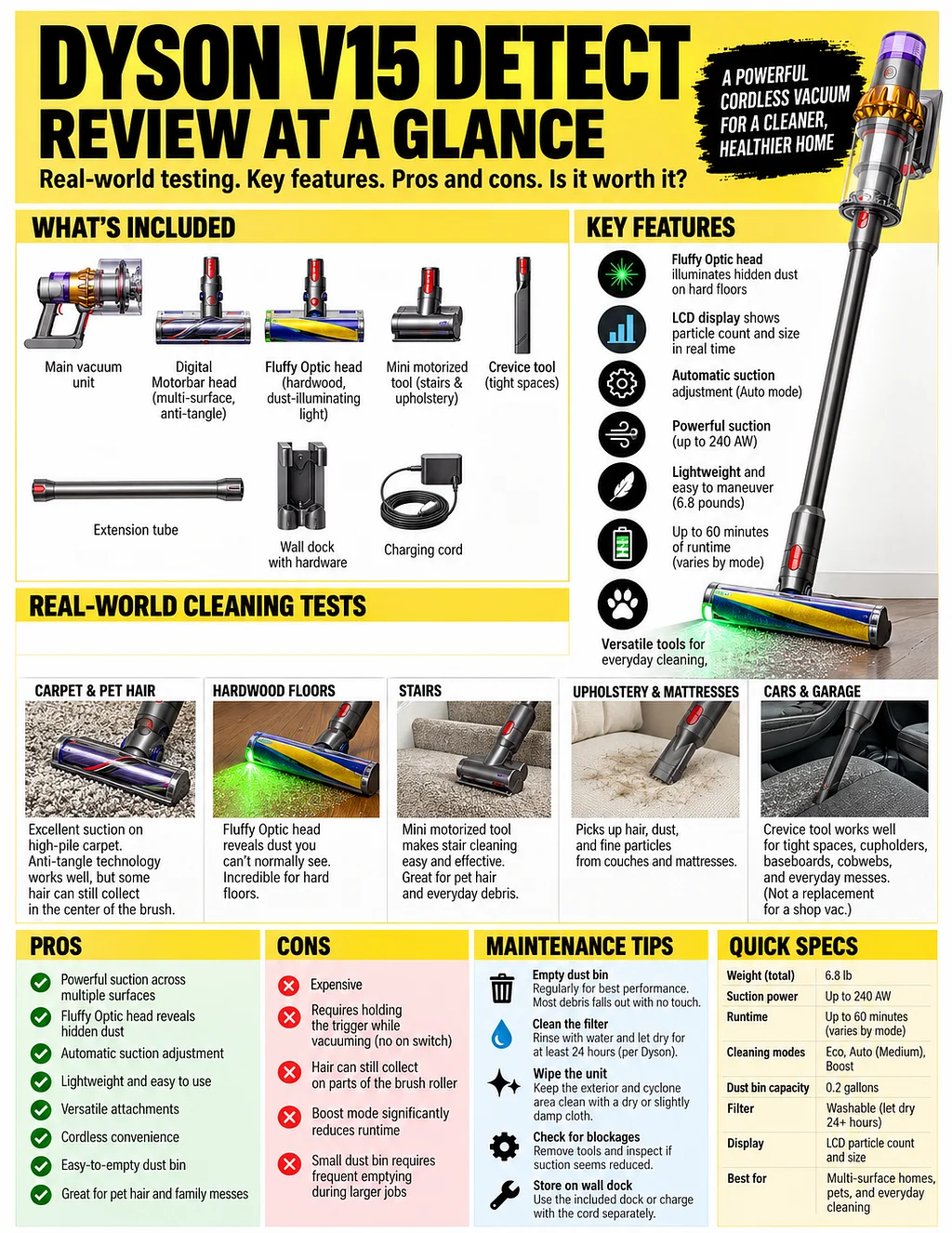
Dyson v15 Detect
The Dyson V15 Detect takes cordless cleaning to another level! Featuring powerful suction up to 240 air watts, a Fluffy Optic cleaner head that illuminates hidden dust, automatic suction adjustment, real-time particle tracking on an LCD screen, and up to 60 minutes of runtime, this lightweight vacuum is built for everyday messes. With specialized attachments for carpets, hardwood floors, stairs, furniture, and tight spaces, it's a versatile cleaning tool for busy households.
🛒 Ready to upgrade your cleaning routine? Check out the Dyson V15 Detect at Lowe's and see if it's right for your home!
Lowe's partner. This is a promotional link; I may earn a commission from qualifying purchases.
Disclaimer: This image was created using AI for illustrative purposes and may not accurately represent the product or its features.